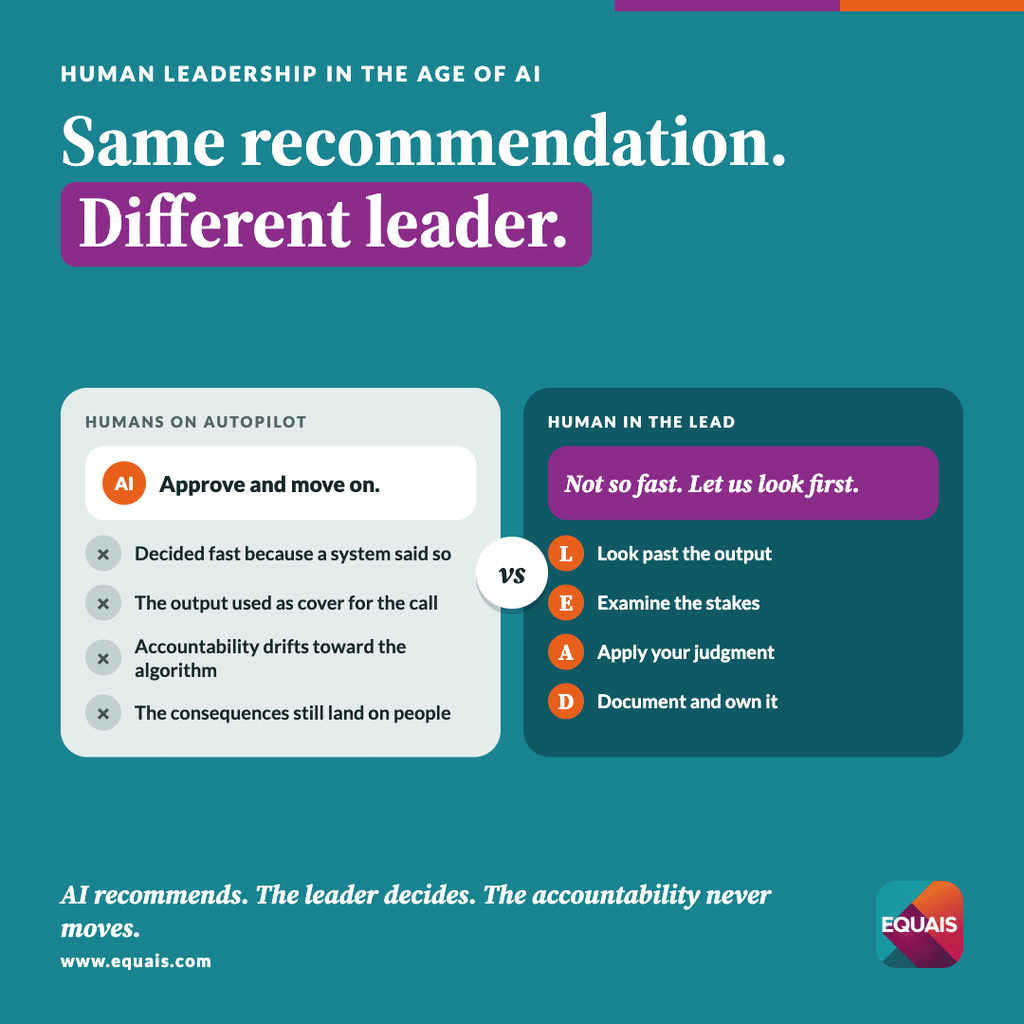
A team lead opens her laptop on Monday morning. Overnight, an AI tool has ranked the quarter’s projects, drafted the priorities, and suggested where to cut.
It looks thorough. It reads well. And it is ten minutes before her meeting.
So she shares it more or less as it is. Nobody in the meeting questions it either, because it came from the system, and the system usually knows.
Nothing about that morning is unusual anymore. That is exactly why it deserves a closer look. AI did not make a bad decision there. But nobody really made a decision at all.
When AI quietly widens the gap
At EQUAIS, we talk a lot about the activation gap, the distance between what people do and what they can do. Most of the time it shows up as silence. The person with the better idea who does not say it. The manager who does not push back.
AI was supposed to help with this, and in many ways it does. It takes away routine work and frees up time for thinking. But we are noticing something else too. When an answer arrives fully formed and confidently worded, it becomes even easier to stay quiet.
Why challenge a recommendation when the tool has already done the analysis? Why share a half-formed idea when a polished one is a prompt away? The silence that used to come from hierarchy can now come from the machine.
So AI does not close the activation gap on its own. Depending on how people lead with it, it can narrow the gap or quietly make it wider.
What stays human
It helps to be honest about what AI is good at. It can process more information than any of us, spot patterns we would miss and draft in seconds what used to take an afternoon. Pretending otherwise does not help anyone.
But leadership was never only about having the right information. Some parts of it stay firmly with people.
Judgment. AI can tell you what is likely. It cannot tell you what matters most to your team, your customers or your values this quarter. Weighing that is still a human call.
Context. The tool does not know that a key engineer is close to burnout, or that a client relationship is more fragile than the numbers suggest. You do.
Trust. People follow leaders, not dashboards. When a hard decision lands, your team needs to know that someone thought it through and stands behind it.
Accountability. An algorithm cannot own a decision. If something goes wrong, “the system recommended it” is not an answer your team, your board or your clients will accept.
None of this makes AI less useful. It simply means the most valuable leaders will not be the ones who use AI the most. They will be the ones who know when to question it.
A simple habit: LEAD
Knowing that judgment matters is one thing. Using it at ten minutes to nine on a Monday is another. That is why, in our Leadership in the Age of AI workshop, we work with a short framework called LEAD. It is designed to be remembered under pressure.
L: Look past the output. Before you accept a recommendation, ask what it is based on. What data went in? What might be missing? A confident answer is not the same as a correct one.
E: Examine the stakes. Not every decision needs the same scrutiny. Choosing a meeting slot is not the same as restructuring a team. The higher the impact on people, money or reputation, the more human attention it deserves.
A: Apply your judgment. Bring in what the tool cannot see: your context, your values, the people involved. Then ask your team. Often the most useful input is the one nobody offered because the AI had already spoken.
D: Document and own it. Make the decision yours. Note what you considered, what you changed and why. This is not bureaucracy. It is what lets your team trust the decision and learn from it later.
Go back to the team lead on Monday morning. With LEAD, she still uses the AI’s draft. But she spends five minutes checking what it assumed, flags the one cut that affects her most experienced people, and asks the room what they think before anything is final. Same tool. A very different meeting.
What this means for organisations
Most companies are investing in AI tools right now. Far fewer are investing in the people who have to lead with them. Yet that is where the return is decided.
A tool rolled out to a team that never questions it will produce faster work, but not necessarily better decisions. A tool in the hands of leaders who know when to trust it, when to challenge it and how to bring their team into the conversation is a very different investment.
This is the thinking behind Leadership in the Age of AI. It is a practical workshop for managers and team leads who already use AI in their work and want to lead with more confidence because of it, not less. We explore what AI genuinely cannot do, where it can make decisions worse, and how to build the LEAD habit into everyday leadership.
Like all our programmes, we shape it around your team. Some organisations bring it in alongside an AI rollout. Others use it to help newer managers find their voice in a world where the machine always seems to have an answer ready.
A question to take with you
Think about the last AI recommendation you passed on to your team. Did you decide, or did you forward?
There is no shame in the answer. Most of us are still working out what good leadership looks like with these tools in the room. But it is worth asking, because the future of leadership will not be decided by how clever the technology becomes. It will be decided by how human we choose to stay while using it.
If this is a conversation your organisation is having, we would be glad to be part of it.
Read more about our “Human Leadership in the age of AI” workshops here – https://www.equais.com/human-skills-in-the-age-of-ai/