In short: strong engineers are often promoted because they are excellent at their technical work, yet leading a team asks for a different set of skills. Research on promotions suggests companies routinely reward current performance over management potential. The fix is not to stop promoting experts, but to choose more deliberately, prepare people before the move, and support them through the first months.
Picture a familiar scene. The best systems engineer in the department becomes team lead. Six months later, she is working evenings to review every design herself, her one-to-ones keep getting cancelled, and two of her strongest colleagues have quietly updated their CVs. Nobody did anything wrong. The company asked her to do a new job without telling her it was a new job.
Why this keeps happening
In most technical organisations, the visible route to more pay and more influence runs through management. So the people best at the technical work are first in line.
Research backs this up. A study of sales workers across 131 US firms, published in the Quarterly Journal of Economics, found evidence of the Peter Principle: companies weighted current job performance in promotion decisions over characteristics that better predicted management performance, and the cost of that mismatch was high. Gallup reports that when it asked US managers why they were chosen, they commonly cited success in a previous non-managerial role or their tenure.
Preparation rarely makes up for it. In the UK, the Chartered Management Institute found that 82% of people entering management roles had no formal management training. It calls them accidental managers.
The five shifts from expert to manager
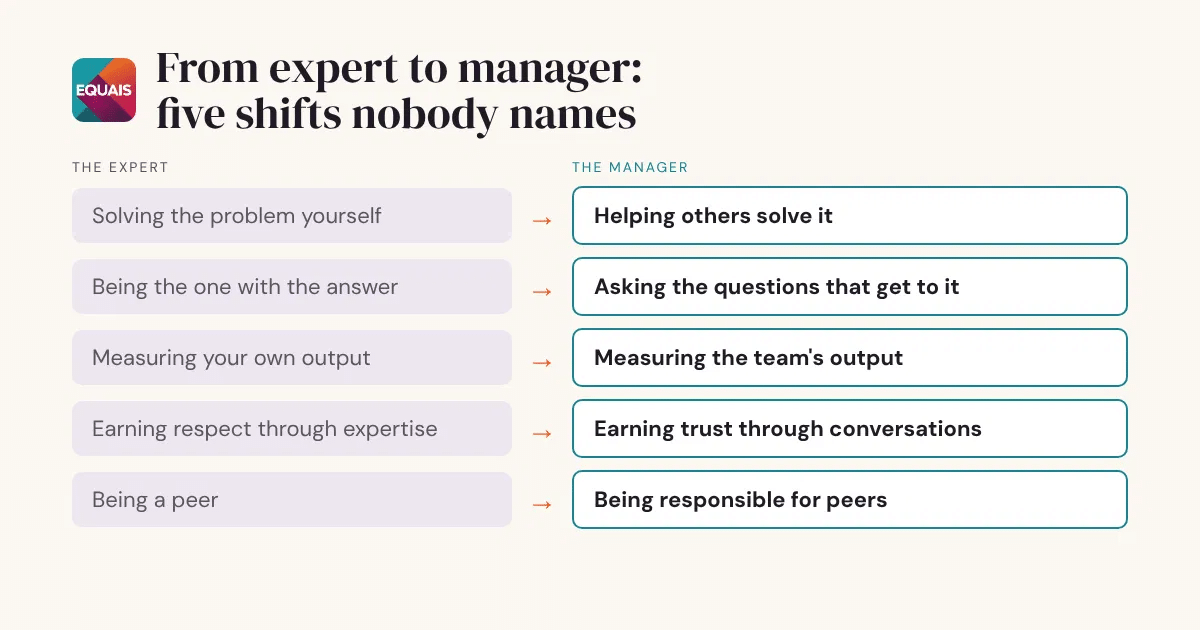
The struggle is rarely about intelligence or motivation. It is about five shifts that nobody names.
| From | To | What it looks like when the shift has not happened |
|---|---|---|
| Solving the problem yourself | Helping others solve it | The lead reviews or redoes every piece of work and becomes the bottleneck |
| Being the one with the answer | Asking the questions that get to it | Team members stop offering ideas because the lead always knows better |
| Measuring your own output | Measuring the team’s output | A busy calendar feels like progress while the team stalls |
| Earning respect through expertise | Earning trust through conversations | Feedback, conflict and performance issues are postponed |
| Being a peer | Being responsible for peers | Old friendships make honest conversations awkward, so they do not happen |
Each shift asks the new lead to let go of the thing that made them successful. That is why it feels like a loss, and why so many quietly slide back into technical work.
What it costs when the transition goes wrong
The cost does not stay with the new manager. The CMI survey found that one in three people had left a job because of a negative relationship with their manager. In technical teams, the people who leave first are often the strongest, because they have the most options. Our guide on what it costs when people leave shows how quickly that adds up.
There is also a quieter cost. A brilliant engineer spending half her week on tasks she feels unprepared for is a brilliant engineer not doing engineering.
What companies can do
- Offer a real expert career path. Many engineering companies run a technical career track alongside the management track. When it carries comparable pay and status, people move into management because they want to lead, not because it is the only way up.
- Select for management potential, not only technical excellence. Before the promotion, look for evidence of the skills the role needs: helping colleagues, handling disagreement, explaining complex work simply.
- Prepare before the move, not after it. A short programme before or at the start of the role is far cheaper than repairing a team later.
- Support the first six months. Regular, short sessions work better than one intensive seminar, because the new lead can apply each step to real situations and come back with questions.
- Protect some technical time, deliberately. New leads who lose all technical contact can lose confidence and credibility. A planned, limited amount keeps both.
How we approach it
Our first-time manager workshop focuses on the gap between technical mastery and leading the people who used to be your peers. For organisations with several new leads a year, we build it into a longer programme so each shift gets practised, not just discussed. You can read more about the formats in our guide to leadership development for mid-sized companies.
Learn about our workshops here: https://www.equais.com/the-first-time-manager/