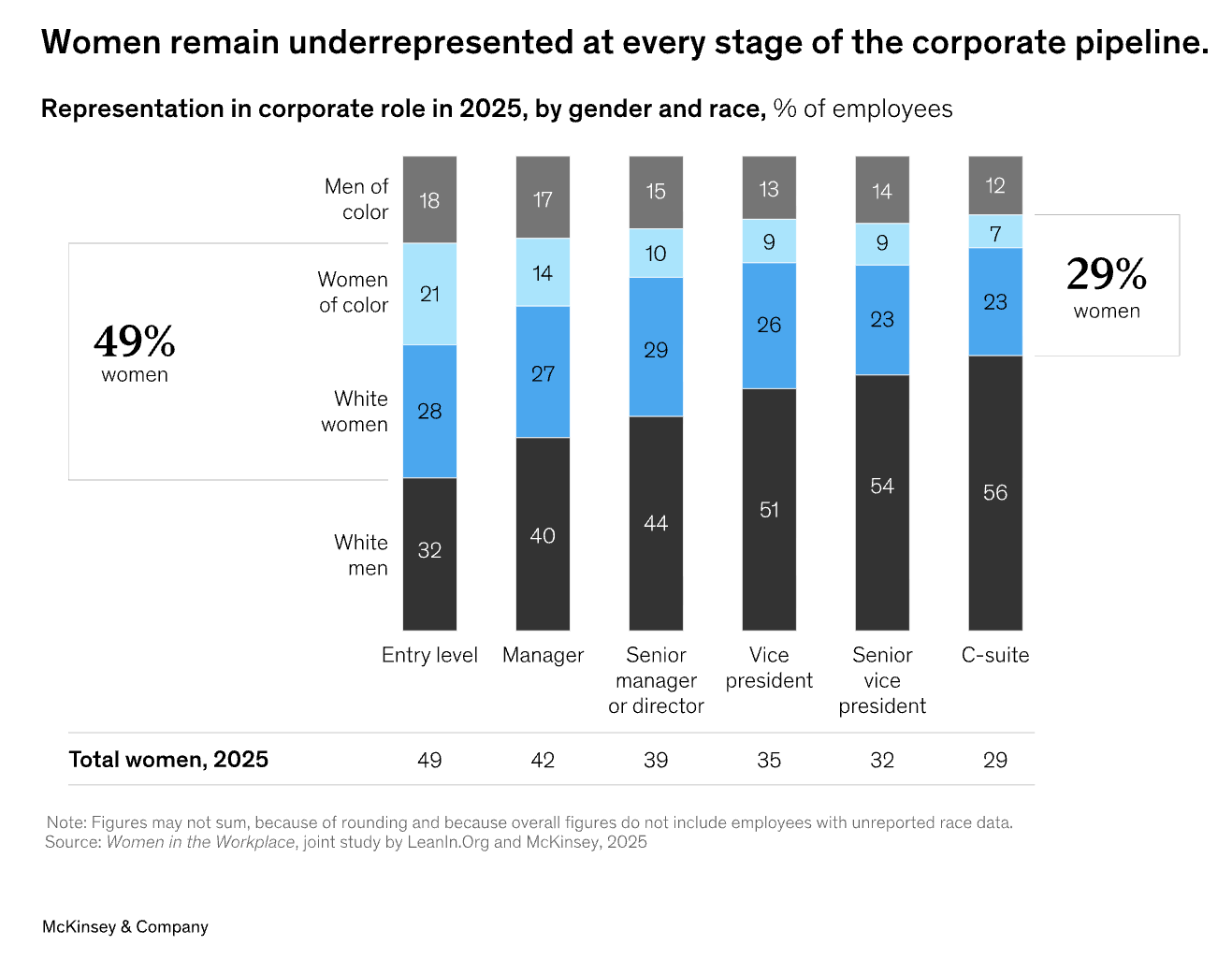


McKinsey & Company’s Diversity Wins research examines the relationship between leadership diversity and financial performance across more than 1,000 global companies. The study finds a clear correlation between diversity in executive teams and business outcomes: organisations in the top quartile for gender diversity on executive teams are 25 percent more likely to achieve above-average profitability than those in the bottom quartile. For ethnic and cultural diversity, the advantage grows even stronger, with top-quartile companies showing a 36 percent likelihood of financial outperformance compared to less diverse peers. These findings hold even after accounting for industry, geography, and organisational size, suggesting that diversity itself is a meaningful predictor of competitive advantage. (source: McKinsey)
Importantly, Diversity Wins emphasises that representation alone is not sufficient. Companies that simply hire diverse talent without enabling influence, voice, and equitable decision-making do not reap the same financial benefits. The research shows that inclusion — the active integration of diverse perspectives into leadership processes, strategy discussions, and decision systems — is what drives performance outcomes. Organisations that embed fairness into promotion pathways, leadership evaluation criteria, and accountability systems are more likely to convert diversity into tangible business value.
For organisations facing talent shortages, competitive pressure, and innovation demands, the McKinsey data makes a compelling argument: structural fairness and leadership diversity are not just ethical imperatives, they are business imperatives.
Read more here: https://www.mckinsey.com/featured-insights/diversity-and-inclusion/diversity-wins-how-inclusion-matters