Every organisation has one. The engineer who can solve any problem you put in front of them. The analyst whose numbers are always right. The specialist everyone calls the moment something breaks.
And yet, year after year, they stay in the same seat while others move ahead. It is rarely a question of talent. They earned their place in the room. What happens once they are inside it is a different story, and that story is what we call the activation gap.
Technical skills get you in the room
Technical skills are the entry ticket. They carry your CV, win the interview, and earn the first promotions. In the early years of a career, mastery is the job, and the reward for doing it well is more of it.
Then something shifts. The further you go, the more your results depend on other people. A decision has to be made. A budget has to be approved. A team has to pull in the same direction. An idea has to be heard before it can be used.
At that point the question quietly changes. It is no longer “Can you do this?” It becomes “Can you get this done with and through others?” Technical skill alone cannot answer that question.
What is the activation gap? 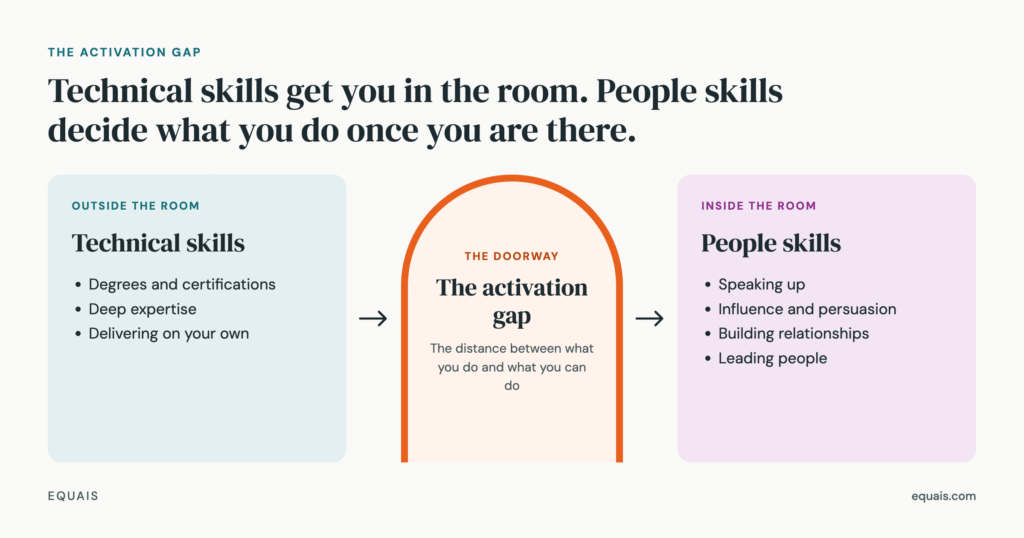
The activation gap is the distance between what you do and what you can do.
Technical skills get you in the room. People skills decide what you do once you are there. That distance is the activation gap.
It is not a lack of ability. The knowledge, the ideas, and the judgement are already there. What is missing is the switch that turns them into influence and impact: the ability to speak up, to explain, to persuade, to build relationships and to lead people.
These are often called soft skills, which makes them sound optional. They are not. They are the skills that activate everything else you know. And like any skill, they can be learned, practised and strengthened.
What the activation gap looks like?
The activation gap rarely announces itself. It shows up in small, familiar moments.
For individuals:
- The idea that stays unspoken in a meeting, until someone else says it ten minutes later and gets the credit.
- The expert promoted to manager who keeps doing the technical work, because leading former peers feels harder than solving problems.
- The appraisal where a year of real contribution is summed up in a few modest sentences.
- The network that ends at the team door, so opportunities pass by unseen.
For organisations:
- Meetings where the same few voices shape every decision.
- Teams that are capable on paper but not aligned in practice.
- A culture where it does not feel safe to challenge, question, or share a half-formed idea.
- Innovation that never surfaces, because the people holding it never found the room to say it.
Why the activation gap matters to the business
Organisations hire for capability. When that capability is not activated, they pay for it and never see the full return.
The cost is easy to miss, because it never appears as a line on a balance sheet. It shows up instead as slower decisions, ideas that stay in people’s heads, managers who struggle to lead, and talented people who leave because they feel unseen.
Closing the gap is not about adding more talent. It is about getting more from the talent that is already in the room.
How to close the activation gap
The good news is that people skills respond to practice in the same way technical skills do. A few places to start:
- Treat people skills as skills. Not personality, not talent you either have or lack. Something you can learn, rehearse, and improve.
- Speak up early and often. Start in lower-stakes settings, such as a team meeting or a project update, and build from there.
- Translate your work into impact. Explain what your expertise means for the team, the client, or the business, not only what you did.
- Build relationships before you need them. A network is far easier to use when it already exists.
- For leaders and HR teams: build the room. Create meetings where it is safe to speak, and prepare new managers before the promotion, not after it.
The room is only the beginning
Your technical skills got you here, and they will keep mattering. They were simply never designed to carry you the whole way.
At EQUAIS, we work with leaders and teams across Europe to close the gap between what they do and what they can do. If you have recently stepped into your first management role, or are about to, our First Time Manager workshop is built for exactly that moment: the shift from being the expert to leading the people around you.