
How unequal pay persists through design, not accident, and what the numbers reveal about who pays the price.
There is a version of this story that companies tell well. They publish diversity reports. They hire Chief People Officers. They run unconscious bias training and paste the word inclusion across their career pages. And yet, year after year, the numbers stay more or less the same. Women still earn less. Immigrants still earn less. Women of colour earn considerably less still. This is not a coincidence. It is a design.
The pay gap is not simply a relic of the past that is slowly being corrected. In some measures, it is widening. Understanding why requires looking not just at what companies say about pay, but at how they have structured compensation systems in ways that allow inequality to persist quietly, legally, and with remarkable consistency.
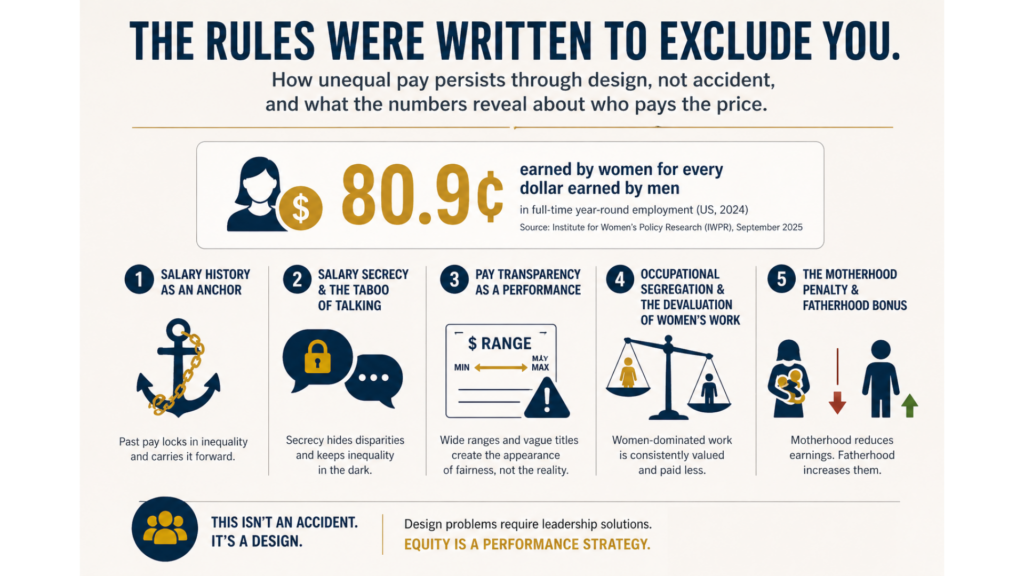
80.9 cents earned by women for every dollar earned by men in full-time year-round employment (US, 2024) Source: Institute for Women’s Policy Research (IWPR), September 2025
A gap that is getting worse, not better
The Institute for Women’s Policy Research reported in September 2025 that the gender wage gap in the United States actually worsened in 2024, marking the second consecutive year of decline. Full-time, year-round working women were paid just 80.9 cents for every dollar earned by their male counterparts, down from 82.7 cents in 2023 and 84 cents in 2022. It is the worst ratio since 2016, and the biggest single-year drop since 1966.
The Economic Policy Institute, controlling for race, ethnicity, education, age, and state, found that women were paid 18.0 percent less per hour than men in 2024. The picture becomes more troubling when race and ethnicity are layered in. According to their analysis, Black women earn only 69.6 percent of what white men earn. Hispanic women earn just 65.3 percent, a gap that translates to over 21,500 US dollars less per year for a full-time worker. (Sources: Institute for Women’s Policy Research (IWPR), September 2025; Economic Policy Institute (EPI), Equal Pay Day Analysis, March 2025)
“Economic progress does not automatically translate into equity for women.” – Dr. Jamila K. Taylor, President and CEO, IWPR
At the global level, the World Economic Forum’s 2024 Global Gender Gap Report found that only 68.6 percent of the overall gender gap has been closed, and at the current rate of progress, the World Economic Forum estimates it would take 134 years to reach full parity. The European Union’s own Eurostat data for 2024 placed the unadjusted gender pay gap at 11.1 percent, with wide variation between countries, from near parity in Luxembourg to an 18.8 percent gap in Estonia. (Sources: World Economic Forum, Global Gender Gap Report 2024; Eurostat Gender Pay Gap Statistics, 2024)
The machinery behind the gap
Loophole 1: Salary history as an anchor
For decades, it was standard practice for employers to ask job candidates what they currently earned or had earned in the past. On the surface, this seems like a reasonable way to benchmark compensation. In practice, it does something far more insidious: it locks in whatever inequity existed in a person’s previous role and carries it forward into every subsequent position they hold.
If a woman or a person of colour was underpaid in their last job, as statistics consistently show they are, then basing a new offer on that history does not correct the problem. It compounds it. Each negotiation begins from a lower floor, and the gap widens over the course of a career, not because of the choices made in any single moment, but because a structurally unequal starting point is treated as a neutral data point.
A growing number of US states have introduced salary history bans in response to this. But as of 2026, there is no federal law prohibiting the practice, and enforcement in jurisdictions that do have bans remains inconsistent. Outside the United States, the problem is largely unaddressed in law altogether. (Source: Center for American Progress, Quick Facts About State Salary Range Transparency Laws, 2023 (updated 2025))
Loophole 2: Salary secrecy and the taboo of talking
In many workplaces, discussing your salary with colleagues is treated as a social infraction. Employees are sometimes explicitly told that their compensation is confidential. While the US National Labour Relations Act technically protects workers who discuss wages, culture does most of the enforcement that the law cannot. People simply do not ask, and so they do not know.
Salary secrecy is not neutral. Research has shown that it actively enables disparities by removing the information people would need to identify and challenge unequal pay. The Center for American Progress notes that women are more hesitant than men to negotiate salaries in the first place, and when they do, they typically ask for less and are penalised more. But research also consistently shows that when women know what to expect from a negotiation, those gender differences diminish. Secrecy, in other words, disproportionately harms those who already negotiate from a position of less power. (Source: Center for American Progress, 2023; National Labour Relations Act (NLRA))
Loophole 3: Pay transparency as a performance
In response to growing legislative pressure, many companies have moved toward publishing salary ranges in job postings. On paper, this seems like progress. In practice, the implementation often renders the disclosure meaningless.
Companies have discovered several ways to technically comply with transparency requirements while continuing to obscure meaningful information. These include posting deliberately wide salary ranges that can span tens of thousands of dollars, using vague or non-standard job titles to make comparison difficult, and leaving older listings live to avoid having to disclose ranges on newer postings.
A researcher at Indiana University’s Kelley School of Business, speaking to Newsweek, summarised the problem precisely: when posted ranges are wide, as they often are, there remains significant room for post-negotiation pay disparities, which means the policy aimed at closing gaps may do little to address them at all. Pay transparency laws have reduced the gender pay gap by an estimated 20 to 40 percent in jurisdictions with strong implementation, but weak implementation can give the appearance of change without its substance. (Sources: Newsweek, August 2024; Factorial HR, Pay Transparency in 2026; BeamJobs, Updated Pay Transparency Laws, 2024)
20-40% Estimated reduction in gender pay gap in jurisdictions with strong pay transparency law implementation (Source: Factorial HR, Pay Transparency in 2026)
Loophole 4: Occupational segregation and the devaluation of women’s work
Perhaps the most enduring structural loophole is one that does not appear in any HR policy at all. Industries and roles historically dominated by women, including education, care work, administrative support, and nursing, consistently offer lower wages than comparable roles historically dominated by men, even when the levels of skill, education, and responsibility are equivalent.
The National Bureau of Economic Research notes that industry and occupation together account for roughly half of the observed gender pay gap. This is not simply because women choose lower-paying sectors. It is because the valuation of sectors follows the gender of the people in them. When women enter a field in large numbers, wages in that field tend to decline over time. When men enter a field previously dominated by women, wages tend to rise. The pattern is consistent and well-documented.
Occupational segregation functions as a loophole because it allows companies to pay women less without ever technically paying any individual woman less than any individual man in the same role. The discrimination is built into the architecture of the labour market rather than the terms of an individual contract. (Source: National Bureau of Economic Research (NBER), Gender Inequality in the Labor Market, Working Paper 33266, December 2024)
Loophole 5: The motherhood penalty and the fatherhood bonus
The intersection of caregiving and career reveals one of the most striking and least discussed dimensions of the pay gap. Research from Columbia University, cited in Payscale’s 2026 Gender Pay Gap Report, found that women earn half as much following childbirth, and that their earnings remain suppressed for years afterward, including for women who are the primary breadwinners in their households.
Payscale’s own 2026 data shows that women who are parents or primary caregivers earn 74 cents for every dollar earned by men in similar uncontrolled comparisons, one cent wider than the previous year. The contrast with men who become fathers is instructive: studies consistently find that fatherhood is associated with a wage premium, as employers perceive fathers as more committed and stable. The same parenthood that penalises women benefits men, not because any individual manager is calculating this consciously, but because the assumptions embedded in how companies evaluate performance, availability, and ambition disproportionately reward those who can perform uninterrupted full-time presence. (Source: Payscale, 2026 Gender Pay Gap Report, March 2026)
The immigrant pay gap: A compounded disadvantage
The conversation about pay inequality would be incomplete without addressing what happens to workers who arrive from somewhere else. The migrant pay gap is both substantial and structurally similar to the gender pay gap in how it is maintained.
According to the International Labour Organization, migrants in high-income countries earn nearly 13 percent less on average than national workers, with disparities reaching 42 percent in Cyprus, 30 percent in Italy, and 25 percent in Austria. In the United States, a major study published in Nature in July 2025, analysing linked employer-employee data from over 13 million people across nine countries, found that immigrants earn 10.6 percent less than similarly educated US-born workers. (Sources: International Labour Organization (ILO), Migrant Pay Gap Report; UMass Amherst, Nature Study, July 2025)
10.6% Less than similarly educated native-born workers earned by US immigrants, with 75% of the gap driven by restricted access to high-paying jobs (Source: University of Massachusetts Amherst / Nature, July 2025)
Critically, the Nature study found that about three-quarters of the immigrant wage gap was driven not by unequal pay for the same job at the same employer, but by structural exclusion from higher-paying workplaces altogether. Immigrants are sorted into lower-paying industries, occupations, and companies through hiring practices, credential non-recognition, network effects, and explicit discrimination at the recruitment stage.
Migrant women face a double disadvantage. The ILO estimates that the pay gap between male nationals and migrant women in high-income countries reaches nearly 21 percent per hour, exceeding even the standard gender pay gap. Migrant women make up a disproportionate share of domestic and care workers, sectors with some of the lowest wages and weakest protections in any economy.
The mechanisms sustaining the migrant wage gap mirror those of the gender pay gap in important ways: credential and experience non-recognition that functions like salary history bias, exclusion from networks that control access to better-paid roles, concentration in sectors that are undervalued in part because they are migrant-dominated, and immigration status that creates a structural power imbalance in any wage negotiation. (Source: ILO, Migrant Pay Gap; Nature / UMass Amherst Study, 2025; Yale Law School, Unpacking the Migrant Wage Gap, 2024)
Why is this a leadership problem
It is tempting to frame pay inequality as a policy problem or a legal compliance challenge. But at its core, it is a leadership problem. The structures that sustain pay gaps do not maintain themselves. They are maintained by the decisions leaders make, or choose not to make, about how compensation is set, who receives access to opportunities, how performance is evaluated, and which gaps are deemed acceptable.
The activation gap, the distance between what teams are capable of and what the structures around them actually allow, lives here as forcefully as anywhere. An organisation that underpays a significant portion of its workforce is not simply an organisation that has not gotten around to fixing something. It is an organisation whose leadership structures are actively suppressing the contribution of those workers, financially, motivationally, and in terms of the signal it sends about whose work is valued.
The pay gap is not a relic being slowly corrected. In some measures, it is widening. It is a design problem, and design problems require leadership solutions.
Closing the gap requires more than good intentions. It requires pay equity audits conducted with actual rigour, compensation bands that are defined and defended, promotion criteria that are made explicit and monitored for demographic patterns, and leadership cultures where raising pay equity concerns is treated as evidence of strategic thinking rather than personal grievance.
It also requires organisations to stop treating the loopholes as neutral features of the compensation landscape. Salary history policies, wide posting ranges, opaque job architectures, and the absence of caregiving support are choices. So is the decision to change them.
About EQUAIS
EQUAIS is a B2B leadership development company that works with mid-management teams to build more inclusive leadership, reduce unconscious bias, and activate the full potential of human capital through more equitable organisational structures. We believe that equity is not a values statement. It is a performance strategy.
If this article raises questions about how your organisation approaches pay, leadership, and the structures that shape both, we would welcome the conversation.