
By EQUAIS
There is a story European companies have been telling themselves for a while now.
It goes something like this: We are making progress. We are hiring more diversely. We are running inclusion training. We have the data. We have the reports. We are moving in the right direction.
And on paper, parts of that story are true. Diverse hiring has improved. Awareness around bias has grown. More organisations than ever have DEI commitments written into their corporate strategies. But there is a quieter story running alongside this one, and it is far less comfortable to tell. 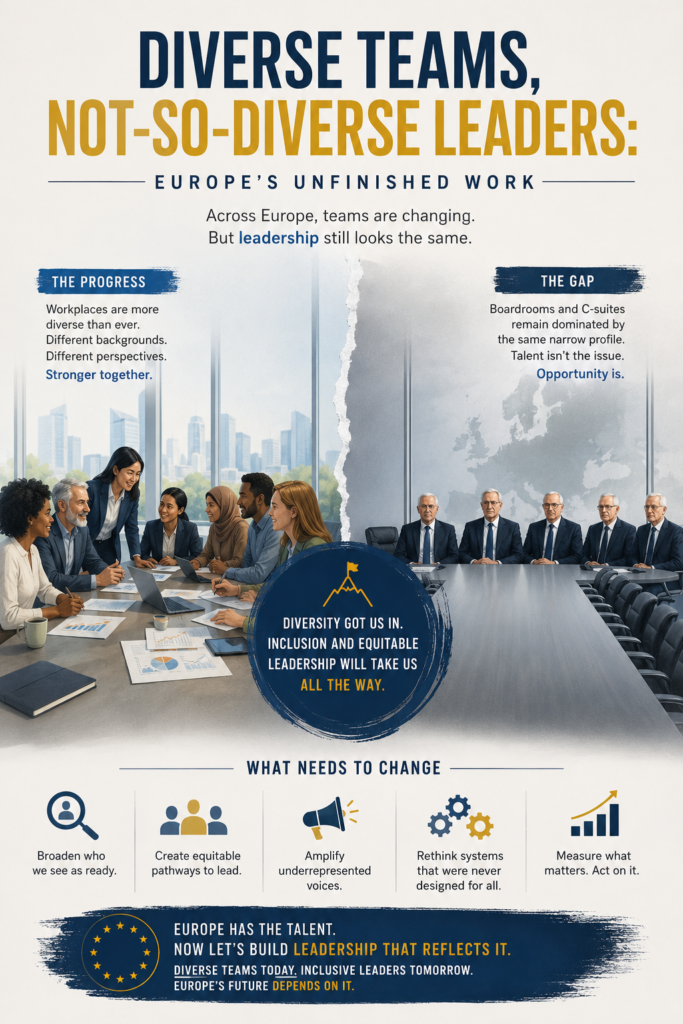
The people getting hired are not the people getting promoted.
The diversity showing up at the door is not making it to the table where decisions are made. And the longer that gap goes unaddressed, the more it reveals something important: that hiring for diversity, without transforming the structures that govern advancement, is not inclusion. It is optics.
The numbers behind the gap
The evidence is not subtle. According to the EY European DEI Index, only 7% of organisations in Europe are building a genuinely diverse and inclusive culture. On the surface, workforces look more representative than they did a decade ago. But move up the hierarchy and the picture shifts dramatically. Across the nine European countries surveyed, only 40% of managers identified as members of underrepresented groups, compared to 61% of non-managerial employees (Source). Strip out gender from that figure, and it becomes even starker: just 16% of managers belong to an underrepresented group, against 31% of employees at the non-management level.
In the tech sector, the pattern is particularly visible. Women make up 40% of the European tech workforce in 2025. But at the executive level, that figure drops to 21% (Source). In Sweden, which routinely ranks among Europe’s most progressive countries on gender equality, women hold just 17% of senior tech leadership roles. Decades of modest representation at the entry level appear to have bred complacency rather than momentum.
The World Economic Forum’s Global Gender Gap Report 2025 confirms that between 2015 and 2024, the share of women in top management roles globally rose from 25.7% to 28.1%. That is progress. But since 2020, the gap between mid-level and top-level leadership has stalled at 5.4 percentage points, suggesting that the pipeline narrows precisely where it matters most (Source). This is not a hiring problem. It is a structural one.
When representation ends at the door
There is a term worth sitting with here: the activation gap.
It describes the distance between what a diverse team is capable of delivering and what the structures around them actually allow. You can fill a room with talented people from different backgrounds, different disciplines, and different lived experiences. But if the systems governing who gets sponsored, who gets assigned to visible projects, and who gets invited to the room where decisions happen remain unchanged, that talent goes untapped.
The frontline manager is often where this gap becomes most acute. Research shows that most managers are promoted for technical performance, not for their ability to develop and advocate for the people around them. Very few receive meaningful training on running structured interviews, giving equitable feedback, or sponsoring talent that looks different from themselves. The result is that diverse employees are hired into teams where the person most responsible for their growth is not equipped to give it.
This is not a personal failing. It is a system gap. And it plays out every day in small, invisible ways: who gets put forward for the high-visibility assignment, whose ideas get taken up in the meeting, who gets the informal mentoring that never appears on any org chart.
McKinsey’s research on inclusive talent strategies puts a number on what this costs Europe. Improving access to opportunity, they found, could increase Europe’s GDP by up to 1.3 trillion euros (Source). That is not a diversity statistic. That is an economic argument.
Why companies miss it
Part of the reason this gap persists is that the metrics most companies use make it easy to miss.
Headcount reports and hiring statistics tell a clean story. You can point to a number and call it progress. But they do not capture promotion rates, attrition among underrepresented groups, who receive mentorship, who get access to stretch assignments, or how included people actually feel in their day-to-day work. According to DHR Global’s 2025 executive survey, only 33% of organisations currently have a senior leader dedicated to inclusion. More than half have never had one at all (Source).
Meanwhile, the EY data reveals something particularly telling about perception. Less diverse leadership teams tend to overestimate how well their organisation is doing on inclusion. Organisations with more diverse leadership teams are significantly more likely to have taken active steps to improve cultural diversity (41% versus 36%), gender diversity (70% versus 57%), and LGBTQIA+ inclusion (27% versus 22%). In other words, experiencing diversity directly changes what leaders can see. Non-diverse leadership is not just a representation problem. It creates a blind spot that shapes every subsequent decision.
When 30% of employees across Europe report experiencing discrimination or bullying in their organisation, but almost half did not report it, that silence is worth paying attention to. It is not apathy. It is a signal about how safe people feel speaking up in the structures they are working within.
The middle is where it gets stuck
One of the most revealing findings from recent research concerns what researchers call the broken rung.
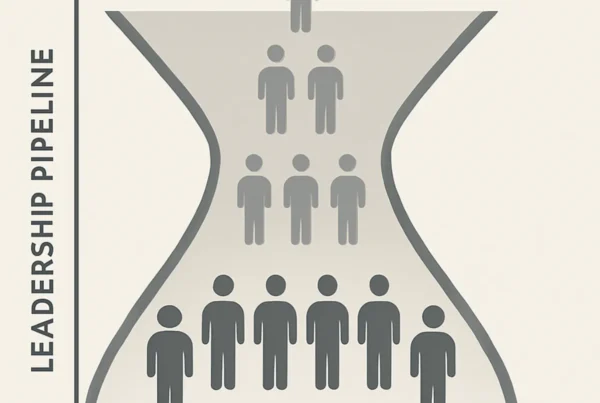
It is not that diverse candidates are failing to reach the top of the ladder. It is that they are falling off somewhere in the middle. The jump from individual contributor to first-level manager, or from mid-level manager to senior leadership, is where representation consistently drops. And because leadership pipelines are built from the middle out, the consequences compound over time. You cannot fill the C-suite with diverse leaders if diverse managers are not being developed, sponsored, and retained at the mid-level.
Scientific research on executive promotion published in 2024 found that women’s probability of being promoted is 16% lower than men’s, after controlling for education, employment background, age, function, seniority, and company characteristics. A significant driver of this gap is that women are more often clustered in support functions rather than the profit-and-loss roles that have historically been the pathway to the top. This is not a reflection of capability. It is a reflection of how opportunity has been distributed.
The WEF data adds another layer: in 2025, women aged 16 to 28 hold 34.8% of leadership roles, while women aged 61 to 79 hold just 18.6%. Generational change is beginning. But it is slow, and it is fragile, and it does not happen on its own.
What Europe is getting right, and where it is stalling
Europe is not standing still on this. Several countries have introduced mandatory board gender quotas, and the effects are measurable. France leads the Global 20 with women representing 45.5% of board members in CAC 40 companies. The UK follows at 43.3%. In the FTSE 350, women now hold 43.4% of board seats, exceeding the 40% target set a decade ago (Source).
But boards are one layer. What sits beneath them tells a different story. In the same FTSE 350, women hold just 7% of CEO roles. Boards can be reformed through legislation. Culture, leadership behaviour, and internal advancement practices cannot.
This is the territory that Europe, and particularly mid-sized companies, have been slower to address. Large corporations have the resources, the public scrutiny, and the regulatory pressure to act. But the bulk of Europe’s employment sits in mid-market organisations, where DEI work often remains informal, underfunded, or limited to a one-day training that no one follows up on.
Germany, where EQUAIS is based, reflects this tension well. Bavarian and broader German industry have made visible commitments to diversity, particularly in sectors like aerospace and manufacturing. But the structures governing how people advance, how leadership is defined, and whose experience counts as relevant, remain largely unchanged. The headline numbers look better than they did. The daily experience of underrepresented employees, particularly at the mid-management level, often does not match their expectations.
The difference between diversity and inclusion
It is worth being precise about language here, because conflating these concepts is one of the reasons the gap persists.
Diversity tells you who is present. Inclusion tells you who has influence. Equity tells you who gets to advance.
A company can achieve the first without the second or third. You can hire diversely and still run a culture where certain people are expected to conform, where leadership style is tacitly defined by what the dominant group recognises as credible, where feedback is given generously to those who fit the familiar template and withheld from those who do not. In that environment, the diverse hire is present. But they are not included. And they are almost certainly not advancing.
The organisations that are actually moving the needle, according to the data, share a few common practices. They hold senior leaders accountable for DEI outcomes, not just DEI commitments. They establish structured mechanisms for surfacing bias in hiring and promotion. They invest in leadership development that includes inclusive management skills. And crucially, they track the metrics that matter, not just headcount, but promotion rates, retention, engagement scores, and who is getting access to the assignments that build careers.
What this means for organisations right now
The business case for addressing the activation gap has never been stronger.
Companies in the top quartile for ethnic and cultural diversity on executive teams are significantly more likely to outperform on profitability. Research consistently shows that diverse leadership correlates with higher innovation, stronger talent retention, and better decision-making. The EU Pay Transparency Directive is creating regulatory pressure that makes representation at senior levels not just an inclusion metric but a compliance risk. And as talent scarcity becomes one of Europe’s defining strategic challenges, the organisations that build equitable advancement systems will have a structural advantage in attracting and keeping the best people.
But the path there is not a training day. It is not a hiring target. It is not a diversity report.
It is a leadership question.
The organisations that will close this gap are the ones whose mid-level managers are being developed to sponsor rather than just manage, to challenge their assumptions rather than trust their instincts, to build equitable feedback and advancement processes rather than rely on informal networks that have always favoured the familiar. That work happens at every level of the hierarchy, but it starts in the middle, where most of the activation gap actually lives.
A final thought
There is something important in the phrase “leadership development.”
Development implies change. Not just knowledge transfer, but a genuine shift in how someone leads, what they notice, and what they consider their responsibility. That kind of development is not comfortable. It requires people to examine how their own behaviour, shaped by years of operating in systems built around a particular image of leadership, might be part of what is holding others back.
That examination is not a weakness. It is precisely the kind of leadership that the data says organisations are missing.
Europe has spent a decade improving the entry point for diverse talent. The next decade belongs to the organisations willing to transform what happens after the hire.
EQUAIS works with organisations to build more inclusive leadership, reduce unconscious bias, and close the activation gap between capable teams and what leadership structures allow them to deliver. If this resonates with what you are seeing in your organisation, we would love to have a conversation.