

Rethinking leadership, inclusion, and system design in modern organisations
Last year, while leading a panel discussion at a tech conference, I found myself in a situation that, on the surface, seemed simple to solve, but in reality revealed something much deeper about how our professional systems are designed.
One of the speakers I had invited was a new mother with a six-month-old baby. She was interested in participating, fully aligned with the topic, and committed to contributing to the discussion, but she had one practical question that many professionals quietly navigate:
“Who will look after my baby during that time?”
It was not an unusual situation. It was simply real life intersecting with professional expectations, something increasingly common in today’s evolving workforce.
My response was immediate and instinctive. I suggested that she come anyway and that we would find a way to manage it together. Given that we were representing women in aerospace, and many of us in the room were women, it felt both natural and reasonable that someone could support her for that short duration while she participated in the panel.
However, when this was communicated to the organisers, the response was clear. It would not be possible. Not because anyone disagreed with the intention, but because the system itself did not allow for it.
When intent is not enough in inclusive workplaces
What stood out in that moment was not the decision itself, but the dynamic behind it. There was awareness. There was empathy. There was no resistance to inclusion. And yet, the outcome remained unchanged.
This reflects a broader challenge across organisations today. Many companies invest in diversity and inclusion initiatives, leadership training, and cultural transformation efforts, yet outcomes remain inconsistent because the underlying systems, decision-making processes, and leadership behaviours have not evolved at the same pace.
Research from McKinsey & Company shows that organisations often struggle to translate diversity efforts into measurable business outcomes when structural barriers persist.
This is where Leadership Behaviour and Decision Quality become critical. Inclusion is not only about intent or awareness. It is about how consistently leaders make decisions that reflect real-world complexity.
The professional model organisations still operate within
Most organisational systems today, whether in conferences, corporate environments, or institutional frameworks, are still built around a narrow and outdated model of what a professional looks like. Someone who is continuously available. Someone who can operate without visible constraints. Someone whose personal realities do not intersect with their professional participation. However, this model does not reflect the modern workforce.
Data from Eurostat highlights that a significant portion of working professionals in Europe manage caregiving responsibilities alongside their careers. At the same time, insights from Gallup show that only about 13 percent of employees in Europe are actively engaged at work, highlighting a growing gap between organisational structures and employees’ realities. These are not edge cases. They are part of everyday organisational life.
This directly connects to Talent, Growth, and Leadership Pipeline, where organisations often overlook capable individuals simply because systems are not designed to support their full participation.
Diversity in the workplace is broader than we design for
When organisations speak about diversity, the focus often remains limited to visible dimensions such as gender or ethnicity. While important, this does not fully reflect the reality of workplace diversity today. Diversity includes:
-
- Life stages such as parenthood and caregiving
- Health conditions and energy variability
- Neurodiversity and different cognitive styles
- Socioeconomic realities and access to opportunity
- Personal constraints that influence participation
When systems are not designed with this broader understanding, inclusion becomes conditional. People may be present, but participation requires effort.
This is where Culture, Influence, and Communication play a key role. What organisations normalise, communicate, and enable through everyday interactions directly shape who feels able to contribute fully.
Designing systems that enable participation, not adjustment
The opportunity for organisations is not only to increase representation, but to build systems where participation does not depend on how much individuals need to adapt. When systems are intentionally designed:
-
- Participation becomes easier and more consistent
- Decision-making becomes more inclusive and effective
- Information flows translate more clearly into execution
- Contribution is driven by structure, not individual effort alone
This is closely linked to Systems, Fairness and Accountability, where organisational processes, policies, and ownership structures determine how fairly and consistently people can contribute. The shift is not about adding complexity. It is about designing systems that reflect reality.
From inclusion to business impact
When systems do not enable full participation, the impact is not only cultural. It is measurable. Organisations experience:
-
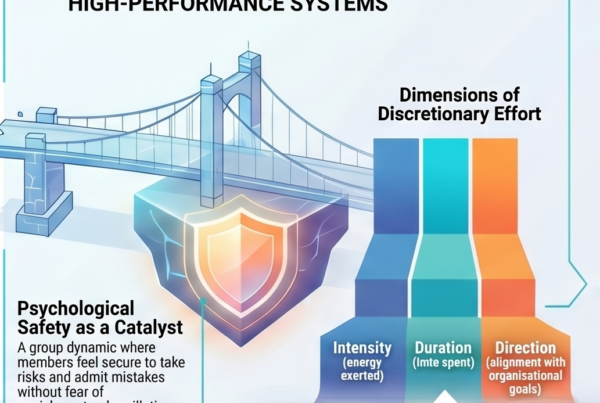
- Reduced engagement and discretionary effort
- Inconsistent decision-making across teams
- Underutilised talent and missed innovation opportunities
- Increased attrition despite capable teams
The World Economic Forum has repeatedly highlighted the link between inclusive systems and improved organisational performance, innovation, and resilience. This is where inclusion moves beyond a social goal and becomes a business performance driver, directly aligning with Business Impact of People Decisions.
A small moment that reflects a larger opportunity
The situation at the conference was not extraordinary. Nothing was visibly broken. And yet, something important was not fully enabled. The speaker did not lack capability. The organisers did not lack intent. But the system was not designed to hold that reality. And this is where organisations today have a significant opportunity to evolve.
Where EQUAIS comes in
At EQUAIS, we focus on how leadership, culture, and systems come together to activate existing organisational talent. Not only who is present within organisations, but also whether systems allow individuals to participate fully, consistently, and without friction. Because most organisations are not short of talent. They are operating within systems that were not designed to fully enable it. Designing systems where everyone can participate fully is not only an inclusion effort. It is a leadership and performance decision.