Why recognising your pressure points matters, and how our Preventing Burnout workshop helps you take the first step
You say yes to one more project. You answer messages late into the evening. You tell yourself it is only for a few more weeks, until the deadline passes or the team settles. And somewhere along the way, carrying it all has quietly become normal. It usually starts with something small. An email you read three times before replying. A Sunday evening that feels heavier than it should. A task you have done a hundred times that suddenly feels like a mountain.
Nothing dramatic has changed. And yet everything feels harder.
This is how pressure works. It rarely announces itself. It builds quietly, over weeks and months, until even manageable demands start to feel like too much. By the time most of us notice, we are no longer managing stress. We are simply getting through the day.
What burnout actually is
The word gets used loosely, so it helps to be precise. The World Health Organization describes burnout as a syndrome resulting from chronic workplace stress that has not been successfully managed. It is characterised by three things: a feeling of exhaustion, a growing mental distance or cynicism towards one’s work, and a drop in how effective we feel in what we do.
That definition tells us something important. Burnout is not a sudden collapse. It is the result of pressure that has been left unattended for too long. Which also means there is a window, often a long one, in which we can notice what is happening and do something about it.
Burnout rarely has one cause
When we talk to professionals about pressure, the story is almost never about a single thing. It builds up across layers.
Unclear roles, where nobody is quite sure who owns what, and the uncertainty quietly lands on the most conscientious person in the room.
Too many tasks, where the list grows faster than it can ever be cleared.
Strained relationships, at work or at home, that take energy we would otherwise use to recover.
Any one of these on its own may feel manageable. The difficulty is that pressure in one area hits much harder when there is little room to recover elsewhere. A demanding project is one thing. A demanding project during a difficult month at home, with a role that keeps shifting, is something else entirely.
And beneath all of this sit our own triggers and vulnerabilities. Two people can face the same workload and experience it in completely different ways. Understanding where your own pressure points are is the starting point for any real relief.
Why this workshop matters
Most of us only pay attention to pressure once it has already taken over. We push through, promise ourselves a rest after the next deadline, and hope it settles on its own. Often it does not.
This workshop creates a deliberate pause before that point. For two and a half hours, you step out of the day-to-day and look at your own situation with clear eyes, guided by someone who has spent over twenty years helping people make sense of how they work.
It matters because awareness on its own is rarely enough. Knowing that you are stretched is very different from knowing where the pressure is coming from and what would actually ease it. The session bridges that difference, so you leave with clarity on your own pressure points and one practical step you can take on Monday morning.
Burning out is not the price of doing well
Many capable people treat exhaustion as proof of commitment. If we are stretched, the thinking goes, it must mean we are working hard enough. But burning out is not a solution to a heavy workload. It is simply the point at which the workload wins.
At EQUAIS, we work on the activation gap: the distance between what people are capable of and what they are actually able to bring to their work. When we take on more than we can handle, that gap widens. The ability is still there, but our energy and focus are spread so thin that the matters that truly count receive the same tired attention as everything else.
The answer is not to care less or achieve less. It is to learn how to manage the load differently: recognising where the pressure comes from, deciding what genuinely needs our attention, and staying calm enough to give it our best. That steadiness is not a personality trait some people are simply born with. It is a skill, and like any skill, it can be learned.
That is exactly what this workshop helps you begin.
Why generic advice rarely helps
Most of us have heard the standard advice. Sleep more. Take a break. Switch off in the evenings. None of it is wrong. But it often fails to land, because it does not start with your situation. If your pressure comes mainly from an unclear role, a weekend away will not resolve it. If it comes from a difficult relationship, a better to-do list will not help much either. Relief tends to come when the response fits the source of the pressure.
That is the thinking behind this workshop.
What happens in the workshop
Preventing burnout: Recognising pressure points and dealing with overwhelm is a 2.5-hour online session designed to move from awareness to action.
1. Explore your pressure points. We begin by looking at where your hardest pressure points currently are, so you know where relief is most needed.
2. Find strategies that fit. You will discover narrative, communication, and physical strategies for dealing with overwhelm, and work out which ones are most likely to suit your specific situation.
3. Leave with a first step. You leave with one concrete step and a short reset you can do at your desk.
You decide how much you share. There is no expectation to discuss anything personal you would rather keep to yourself.
Your facilitator
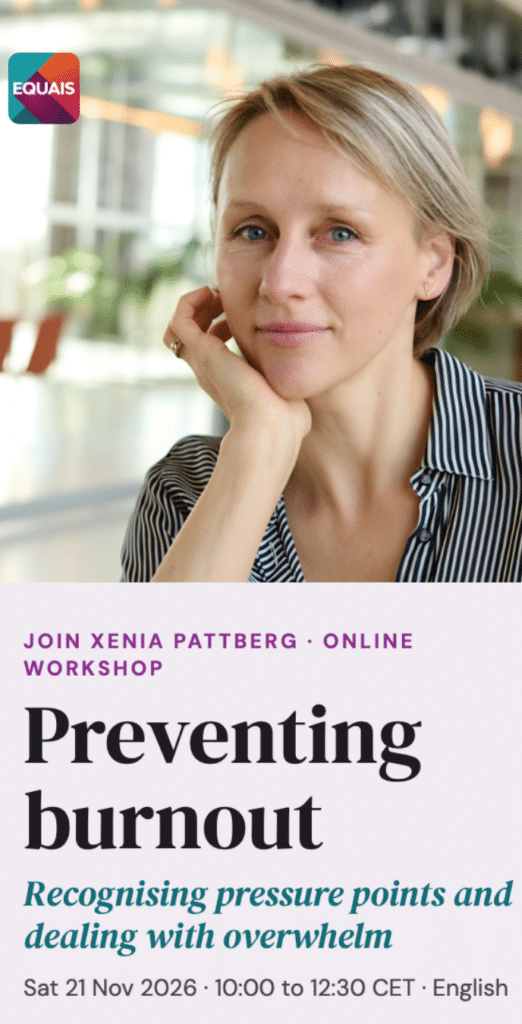
The session is led by Xenia Pattberg, a narrative coach and communications professional trained in organisational psychology. For over twenty years, Xenia has worked with individuals and teams across industries and cultures, helping people understand the stories they work by and helping teams align on how they communicate and collaborate.
Her approach to burnout prevention looks as closely at roles, workload and relationships as it does at individual triggers, expectations and vulnerabilities. Her work spans aerospace, the arts, academia and the non-profit sector.
Who it is for
- Professionals who feel stretched and want to act before it gets worse
- Managers and team leads carrying pressure from above and below
- Founders and freelancers for whom work never quite stops
- Anyone who wants practical tools rather than general advice
A note on care
This workshop is designed to increase awareness and guide practical first steps. It can work alongside medical or therapeutic support, but it does not replace it. If you are struggling, please speak to your doctor or a qualified professional.
Join this workshop
You do not have to keep carrying everything the way you are carrying it now. If parts of this article feel familiar, take that as a signal. This is a good moment to pause, set some of the weight down, and learn a way of working that leaves room for what truly matters. If your employer would like to cover your seat, simply send the company name and billing address to team@equais.com after booking, and we will issue an invoice addressed to your company.
Book your seat and join us on 21 November, online at 10.00 am. Use code ACP100 for a special discount.