
The talent was always there. The question is why it stopped showing up.
There is a pattern that shows up in organisations more often than most leaders realise. A person joins with energy, ideas, and something genuine to contribute. Six months later, they are quieter in meetings. A year later, they do their job competently but nothing more. Two years later, they leave. And nobody is quite sure what happened. 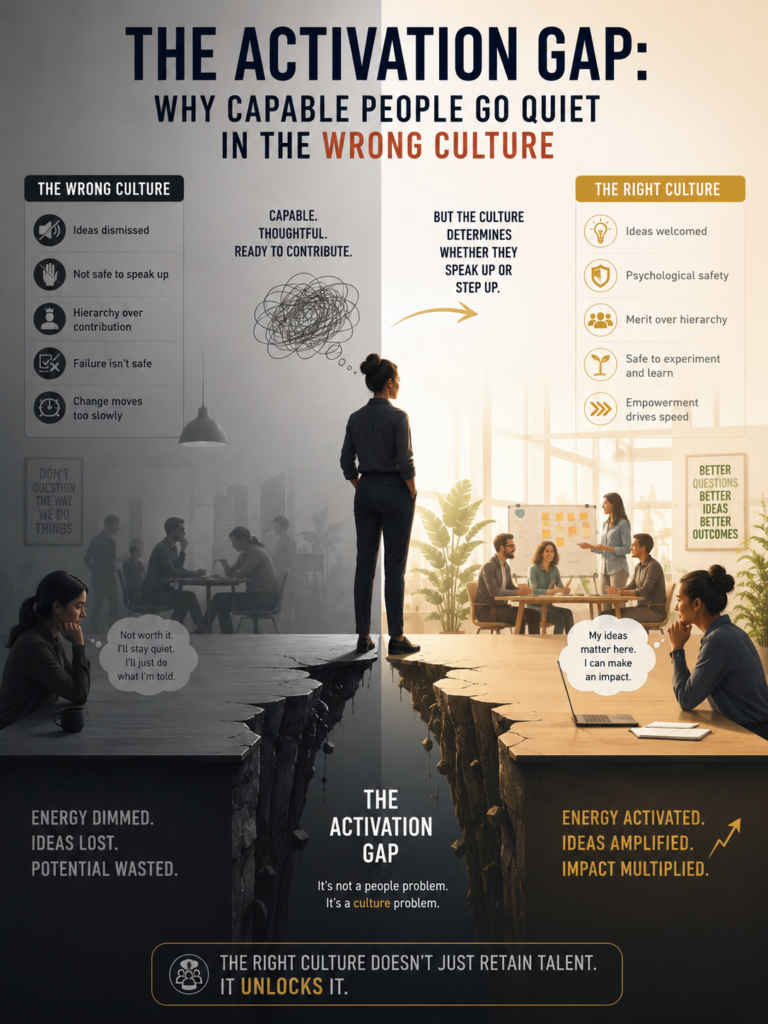
This is not a performance problem. It is not a culture fit problem. It is an activation problem. And it is costing organisations far more than most are willing to calculate.
The scale of the problem
The numbers are difficult to ignore. Gallup’s 2026 State of the Global Workplace report found that only 20 percent of employees worldwide were engaged at work in 2025. The economic cost of that disengagement is an estimated $10 trillion in lost productivity globally. A two-point drop in engagement the year prior alone wiped $438 billion from the world economy. Only 20% of employees worldwide were engaged at work in 2025. (Gallup, State of the Global Workplace 2026)
These are not abstract numbers. They represent the accumulated cost of people who came to work, did the minimum, and withheld the thinking, initiative, and contribution their organisations were counting on. The activation gap is not a niche leadership issue. It is one of the largest preventable costs in business today.
What is the activation gap?
The activation gap is the distance between the capability a person brings into an organisation and the capability the organisation actually draws on. It is the space between potential and expression.
Most organisations assume this gap does not exist, or if it does, it belongs to the individual. The employee is not confident enough, not assertive enough, not good at managing upwards. The deficit is located in the person.
But when you look at the same individual in a different environment, the picture changes entirely. They speak up. They lead. They generate ideas that other people build on. The capability was always there. The conditions were the variable.
What closes activation down
Activation does not close down all at once. It closes gradually, through a series of small signals that accumulate into a pattern.
A person shares an idea in a meeting, and it is ignored. Two weeks later, someone else says the same thing, and it lands differently. A person asks a question that is met with visible impatience. A person raises a concern and is told, explicitly or implicitly, that this is not how things work here.
None of these moments is necessarily intentional. But the person receiving these signals does not experience them as accidents. They experience them as information about whether they belong, whether their contribution is valued, and whether it is safe to keep trying.
Research from McKinsey confirms how rare the right conditions actually are: only 43 percent of employees report a positive team climate, which is the single most important driver of psychological safety. When people do not feel psychologically safe, they protect themselves by contributing less. The activation gap widens. Only 43% of employees report a positive team climate, the primary driver of psychological safety. (McKinsey Global Survey)
Why this is a leadership problem, not a hiring problem
The instinct in most organisations is to solve a talent problem by hiring more talent. But if the environment that closes down activation remains unchanged, the pattern repeats. New people arrive with energy. The same signals accumulate. The same gap opens.
Research from Deloitte found that inclusive teams make better business decisions up to 87 percent of the time and outperform their peers by as much as 30 percent in high-performing organisations. BCG found that companies with above-average diversity in management reported innovation revenue 19 percentage points higher than companies with below-average diversity. But crucially, both research bodies make the same point: diversity alone does not generate these gains. Inclusion does. And inclusion depends almost entirely on how leaders behave. Inclusive teams make better business decisions up to 87% of the time and outperform peers by up to 30%. (Deloitte)
Inclusive leadership is not about being kind or well-intentioned. It is about building the conditions in which every person in the team can actually do their best work. That is both a moral argument and a commercial one.
What activation looks like when it works
When activation is working, you see it clearly. People challenge ideas, including the ideas of people more senior than them, and that challenge is welcomed rather than punished. People bring problems forward before they become crises. Quiet people in meetings are quiet because they are thinking, not because they have learned it is safer to be invisible.
The data reflects this. Organisations that score high on psychological safety indices see 21 percent greater productivity gains, according to McKinsey research. When psychological safety is high, only 3 percent of employees plan to quit, compared to 12 percent when it is low. When psychological safety is high, only 3% of employees plan to quit, versus 12% when it is low. (BCG Global)
Teams with high activation do not necessarily agree more. They often disagree more. But the disagreement is productive because it is built on a foundation of genuine psychological safety. People know that their contribution will be taken seriously, even when it is inconvenient.
The question worth asking
If you look at your organisation honestly, where is the activation gap largest? Which teams have people who have gone quiet? Which managers have direct reports who contribute less than they did when they arrived?
The capability your organisation needs for the next phase of growth may already be inside it. It may just need the right conditions to show up.
About EQUAIS
The activation gap is the problem EQUAIS was built to solve. When capable people go quiet, the cost shows up in disengagement, in avoidable attrition, and in the quality of thinking that never makes it into the room. Closing that gap requires a structured, sustained change in how mid-management teams operate, not a one-day workshop, but a repeatable shift in leadership behaviour that creates the conditions for every person to fully contribute.
EQUAIS works with mid-management teams across Europe through a network of inclusive leadership practitioners. The focus is not on training events or policy updates, but on building the specific leadership behaviours that close the activation gap and allow organisations to draw on the full capability of their people.
If the ideas in this article resonate with what you are seeing in your organisation, the next step is a conversation.
Book a no-obligation call to know more →
Sources
1. Gallup. State of the Global Workplace: 2026 Report. gallup.com/workplace/349484/state-of-the-global-workplace.aspx
2. McKinsey & Company. Psychological Safety and the Critical Role of Leadership Development. mckinsey.com
3. Deloitte. The Diversity and Inclusion Revolution: Eight Powerful Truths. deloitte.com
4. Boston Consulting Group. How Diverse Leadership Teams Boost Innovation. bcg.com
5. BCG Global / Gitnux. Psychological Safety Statistics. gitnux.org/psychological-safety-statistics