At EQUAIS, we often look at organisations through a simple lens: If capability exists, why is it not consistently visible in performance?
Inclusion on Purpose offers a grounded and practical answer to that question. It shifts the conversation away from intent and toward something far more measurable: who gets seen, who gets heard, and who gets opportunities.
Because in most organisations, talent is present. What is missing is the consistency with which that talent is recognised and activated.
The real issue is not talent. It is visibility.
The book makes a clear distinction that is often overlooked in organisations. Performance alone does not determine growth. Visibility plays an equally important role.
There is a common belief that good work naturally gets recognised. In practice, recognition is influenced by access, exposure, and perception. Some individuals are closer to decision-makers, more present in key discussions, and more aligned with what leadership unconsciously associates with potential. Others, despite being equally capable, remain less visible.
This is not a question of effort or motivation. It is a structural gap in how organisations surface and evaluate talent. Over time, this gap leads to an uneven distribution of opportunity, even when capability is evenly distributed.
Systems shape outcomes more than intention
A central theme in the book is that organisations often rely too heavily on individual judgment. Decisions related to hiring, promotion, and recognition are frequently influenced by informal criteria rather than clearly defined standards.
Leaders may believe they are making fair decisions, but without structured systems, those decisions tend to favour familiarity, confidence, or proximity. This creates patterns that are difficult to detect in isolation but become clear over time.
Certain profiles continue to progress, while others remain overlooked. Certain behaviours are consistently rewarded, while others are undervalued. These outcomes are not usually the result of deliberate bias, but they are the result of systems that are not designed for consistency.
From our perspective, this is where organisations begin to lose value. Not through a lack of talent, but through inconsistent recognition of it.
The workplace experience is not the same for everyone
Another important insight from the book is that the workplace is not experienced in the same way by all employees. Even within the same team, individuals can have very different experiences of being heard, receiving feedback, accessing opportunities, and being considered for growth.
These differences are often subtle and rarely documented. However, they influence how individuals engage with their work and how much of their capability they choose to bring forward.
When employees feel consistently overlooked or undervalued, their level of contribution naturally adjusts. Over time, this creates uneven participation across teams. And uneven participation inevitably leads to uneven performance.
Confidence is not the same as capability
The book also highlights a pattern that is widely present but rarely questioned. In many organisations, confidence is often interpreted as capability.
Individuals who communicate assertively, speak frequently, or align with dominant styles of expression are more likely to be recognised as high potential. At the same time, individuals who contribute in different ways may be equally capable but less visible.
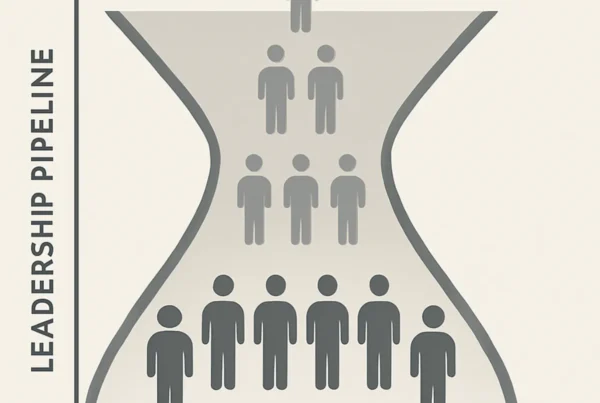
This creates a bias in how talent is identified and developed. Organisations begin to reward visibility rather than capability, often without realising it. Over time, this affects the composition of the leadership pipeline and limits the diversity of thinking at higher levels.
From a leadership perspective, this is a critical gap. It directly influences long-term organisational performance.
Informal networks shape formal outcomes
Another layer the book brings into focus is the role of informal networks. While organisations often rely on formal structures for decision-making, many opportunities are influenced by informal relationships.
Access to leadership, inclusion in informal conversations, and being perceived as familiar or trusted all play a role in shaping outcomes. These factors are rarely acknowledged explicitly, but they significantly impact who gets opportunities and who does not.
When access is uneven, opportunity becomes uneven. And when opportunity becomes uneven, capability is not fully utilised.
What organisations can start doing differently?
The book encourages organisations to move from relying on individual intent to building more deliberate and structured systems.
This begins with making the criteria for hiring, promotion, and recognition more explicit. When expectations are clearly defined, decisions become more consistent and less dependent on subjective judgment. It also becomes easier to identify where gaps exist.
Organisations can benefit from reviewing patterns over time rather than focusing on isolated decisions. Looking at who is progressing, who is being recognised, and who is being overlooked provides a more accurate view of how the system is functioning.
It is also important to create structured opportunities for contribution. When visibility is built into processes, recognition is not limited to those who are naturally more vocal or better connected.
Finally, expanding the definition of what high potential looks like allows organisations to recognise a broader range of capabilities. This leads to a more balanced and effective leadership pipeline.
Why this matters for organisations
In the current environment, where hiring is both expensive and time-consuming, organisations cannot afford to overlook the talent they already have.
When capable individuals are not recognised or developed, the impact is gradual but significant. It appears as slower progression of high-potential talent, reduced engagement, and eventual attrition of individuals who were never fully utilised.
This is not only a people issue. It is a business issue. Every missed opportunity to develop internal talent increases reliance on external hiring, which carries higher costs and greater uncertainty.
A more grounded way to think about inclusion
At EQUAIS, we do not see inclusion as a separate initiative. We see it as a reflection of how well an organisation’s systems are designed.
When systems are clear, consistent, and deliberate, capability becomes more visible. Opportunities become more accessible. Performance becomes more evenly distributed across teams.
In that sense, inclusion is not an end goal. It is an indicator of how effectively the organisation is operating.
Final reflection
What Inclusion on Purpose makes clear is this: Talent does not fail to grow. Systems fail to recognise and develop it.
When organisations rely on informal judgement, capability remains unevenly visible. When they build systems that consistently surface and support talent, more potential is realised. And when more potential is realised, performance follows.
That is where this conversation moves beyond inclusion. It becomes about building organisations where capability is not just present, but consistently activated.
You can buy the book here – https://amzn.to/4dOmq3P